
Depression is not a biological desease
There is no evidence that you have a chemical imbalance in your brain if you are depressed. So therefore, there’s no evidence that that anti-depressant you’re being offered is going to correct that. They haven’t asked that question about what anti-depressants might be doing by just messing about with our normal brain chemistry.
If you subscribe to this idea that you have a brain chemical imbalance, you actually do worse. You have worse outcomes. The psychiatric profession really seemed to me to just want to shut down the debate. They didn’t want people to get an inkling that actually depression has not been proven to be a biological condition.
How many people in our society are on these drugs? So it’s something like 8.7 million people in England who take them. Almost one out of five are taking anti-depressants, which is absolutely staggering.
I think it’s actually still quite prevalent. You can still find it on websites and things like that that depression is caused by lack of serotonin or whatever. So, we’ve had this idea since the 1990s that depression is caused by an abnormality, an imbalance of brain chemicals. Before that, people used to think of depression as a reaction to bad circumstances, you know, unemployment, divorce, child abuse, child childhood trauma. And they saw it as an understandable reaction. Of course, there would be variations between different people. Some people would react more strongly to, you know, being made redundant than others. But that fundamentally it was an understandable human reaction. And then in the 1990s the pharmaceutical industry released their new range of anti-depressant drugs. They wanted to persuade people to take these drugs rather than the old benzodiazepines which had which were prescribed for anxiety and which had got this really bad reputation because they caused quite severe dependency problems. And so to distinguish these new anti-depressants from the old benzodiazepines, they persuaded people, they put out this idea basically that depression is caused is a is a medical disorder that is caused by an abnormality in the brain specifically a deficiency of serotonin which their new drugs happen to be able to put right. So that’s where the idea comes from. This idea that you know depression is this medical condition but it was superimposed onto people’s you know underlying sort of intuition about what depression was which was quite different.
I mean that idea that depression was caused by a chemical imbalance, an abnormality or deficiency of brain neurotransmitters was around. It was first proposed by psychiatrists and researchers working in the 1960s. Again in the context of developing drugs for emotional problems. But it wasn’t sort of widely accepted certainly among the general public and so it was the 1990s when the pharmaceutical industry got involved and conducted these very thorough promotional campaigns that really spread this spread this idea and yes of course they did it in order to sell more drugs and what does the evidence show about this is there any evidence to support the chemical imbalance theory and if it’s if there isn’t what is the evidence telling us about what depression is and where it comes from.
So, so I did a big review of the evidence which was published in 2022 and I wrote my book because of the reaction we got to publishing that paper. The astonishment of you know lots of members of the public and the media that actually there wasn’t good evidence for this theory and push back from the psychiatric procession profession itself and what we did was we got together all the evidence in from different areas of research that have tried to look at whether there are links between serotonin and depression. Now there are thousands of studies uh and so what we did was we got together reviews of the studies in in all the different areas. Now some of those studies find evidence of a link between serotonin and depression and show that serotonin is you know a bit lower in people with depression compared to people without depression. Some of the studies don’t find any difference and some of the studies show that serotonin is a bit higher in people with depression compared to people without. So overall, when you put all the results together, there’s no consistent evidence of an abnormality either way.
SSRI stands for selective serotonin reuptake inhibitor. And they were a range of drugs that started to be introduced in the 1990s or actually late 1980s. The first one was Prozac and the generic name is fluoxetine and they’ve been the most widely used anti-depressants since then although some sort of similar drugs have been introduced over the last 20 years now. SSRI work by inhibiting the transporter protein that takes serotonin out of the gap between the nerves nerve cells where it has its action where it transports the electrical signal from one nerve cell to another. So the SSRI drugs inhibit the protein that takes the serotonin out of that space and therefore the theory is that the serotonin will stay in that space for longer and therefore its activity will be enhanced. That’s the theory. We don’t really understand what they’re actually doing in practice. They probably are having enhanced serotonin activity temporarily. But actually some of the evidence that we looked at in our review and this was a surprise. It wasn’t something that we set out expecting at all. But some of the evidence we came across suggested that people who are on long-term anti anti-depressants actually may have lower serotonin activity rather than higher activity. But I think at this point it’s probably important to clarify that the evidence that serotonin has any impact on mood is very very slim. It’s basically the evidence that we looked at that tests whether serotonin levels are different in people with depression or without depression. And there have been experiments looking at whether serotonin is involved in people’s cognitive functioning as well and animal studies as well looking at that sort of thing. That has not found consistent findings. There’s also research looking at whether serotonin is involved in sleep and appetite. Again, there are no really consistent findings coming out of that body of research. The only thing the only area of our functioning where it seems that there’s fairly consistent evidence that serotonin has an effect is sexual functioning and it’s bad for it. The more serotonin you have, the less likely you are to want sex or for your sexual organs and everything to work properly.
And that’s something that I really wanted to talk about because the we don’t talk enough about the side effects of these types of medication. And you look at the stats of the amount of people who are on them particularly in the US and the UK and in Northern Europe and Scandinavia. It’s I mean one word to describe it is frightening really. Can you give us those numbers, Joanna? How many people in our society are on these drugs?
So it’s something like 8.7 million people in England who take them in England. In England and that works out as something between 15 and 17% of the adult population. One out of five people of the adult population is on antidepressants. Almost one out of five are taking anti-depressants which is absolutely staggering isn’t it? And you know if they were just sugar pills I think there would still be some problems but obviously not sort of major physical problems. But they’re not just you know they’re not inert. They are drugs. They do something. It’s not clear that they do anything much to your mood, but they do, as we’ve said, have this impact on sexual functioning because we know that, you know, because they are doing something to the serotonin system and we know that serotonin is involved in our in our sex lives.
Do you say they don’t do anything for your mood? My understanding I look I’ve never taken anti-depressants so I don’t know but I even if they don’t address the chemical imbalance. I’ve always kind of thought well if you give someone drugs they’re probably going to feel better for a while just cuz they’re on drugs. It’s like if I have a glass of wine tonight I’m going to feel a little bit more relaxed or what is are they not having any effect like that?
So that’s a really good point and I’ve been writing about this for a long time. What you’ve described is the idea that a drug will have some sort of impact on how you’re feeling is what I’ve called the drug centered model of drug action. So it’s that’s one way of understanding what how drugs might affect our moods and our feelings. That contrasts with the mainstream view that what these drugs are doing is targeting some underlying abnormality. So your idea that drugs that enter the brain, you know, are going to change our normal feeling states is correct. If we think of something like alcohol if you can be feeling very depressed, go and out and have a shedload to drink and temporarily you might well feel better again. Obviously, it’s not solving anything um in the moment. Except in the moment. So anti-depressants at least probably most classes of anti-depressants have some emotional numbing effect. We know that because of lots of people describing that. I think it’s you know we’ve probably come across people who are taking anti-depressants and describe how they can’t cry and they don’t feel sort of joy or excitement anymore.
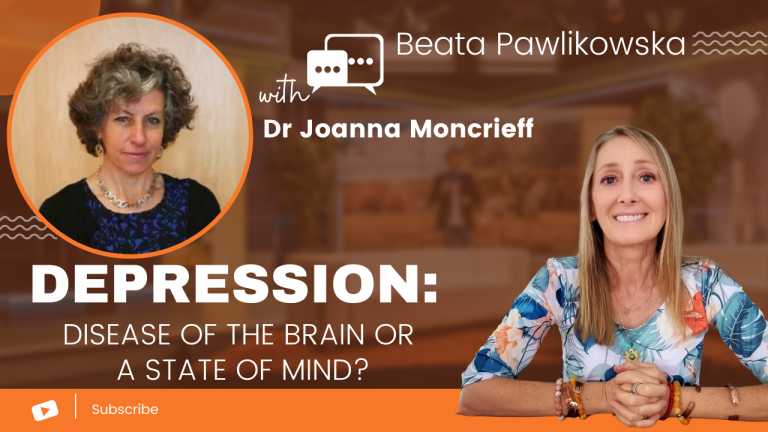
The Truth About Depression – conversation with Dr Joanna Moncrieff